Assignment 1
Three sites have been visited and analysed in accordance with the assignment presented on Lynda's USI course site. These sites will be treated seperately and each site will feature a section pertaining to what information they give, how the navigation works and what media they use.
Further a sample of questions that users might ask is included, and ways how to find this on the various sites.
information given:
title, year of production, artist, technique, dimensions, objectnumber and a picture of the artform, as well as a desription of the history.
pictures of different forms of art present in the Rijksmuseum and a description of what this is. The dimensions, year made and other historical facts about the art. Even the way painters painted their paintings (in the special on the masterpieces the 'nightwatch' is 'disected').
navigational structure:
Different methods are available to get to information.
'Art Objects' gives a lexicographicly ordered list, catalogue gives a topically ordered index. These topics lead to more finegrained categories, which eventually lead to actual objects. It is not readily apparent that the upper group of thumbnails actually are links.
Also the 'geen relatie met index' category is empty in art on paper? As are other
categories, seemingly. Most seem to lead to art within 3 to 4 steps.
Artists gives a lexicographicaly ordered list of artists and their works.
Encyclopedia seems to present different words or people that have been depicted in artform.
Themes lead to the various themes that can be found in art. Typical are 'mythology and religion' and 'people and society'. Exhibitions are also to be found in this section. However when looking under mythology and religion, one finds 'love and sex' as a category. I fail to see the direct link between these, or why l&s is a subcategory of M&r. The reason it is included here, seems to be the lovegod cupid.
A search section is available.
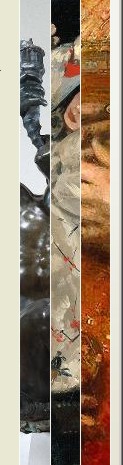
On the right, three strips are also present, which seem to be links to different sections of the site. The one the most to the right is one that seems to link to an interactive part on masterpieces.
media:
Mostly used are pictures, albeit in varying sizes. When selecting an image, one scrolls through a short list by means of 'gesturing' with the mouse. Hovering above one will uncrop this image. Clicking on it depicts an even larger image in the main body. Also, a strip of the image will be depicted to the left of the main body. Hovering over this strip causes it to expand over the main body to show the complete picture in an even larger format. And lastly, below most pictures depicted in the main body a link is present to an enlarged version of this picture that opens in a new browser window.
The interactive part on masterpieces of the site opens a flash animation part. Here one can select images that directly link back into the main body of the site, as well as do, for instance, a goldenage quiz (interactivity).
information given:
titel, author, role, dates, dimensions, keywords and material and a picture of the artform.
navigational structure:
'wie' gives an alphabetical list.
'wat' also gives an alphabetical list, but all is presented on one page.
'waar' does the same. But then for places.
'wanneer' -> links to years do not work for the 20th century. 23253 objects seem to be hidden 'somewhere'.
For art display:
keywords as white text on white background, for increased readability. (not to mention detectability)
Date does not always display correctly.
The search does not seem to work propperly.
media:
pictures mainly and solely.
information given:
artist information. Birthyear and Year of demise.
art information: title, year, type and material, dimensions, location.
navigational structure:
Directory style navigation on the frontpage, and artistlist navigation on the lefthand.
You can go via artists to their art.
The directory style sorts per art style. Within this art style, those painters that are considered part of that art style are listed.
no search available!
media:
Pictures and more pictures. Oh and advertisements.
example questions and sites that answer them:
Each question will treat the three different sites.
- When did Van Gogh live?
Rijksmuseum: search, gogh, any painting, artist, 1853 - 1890.
ICN: search. X 'Wie', G, Gogh, V.W. van, ?
Artchive: Van Gogh, biography, died in 1890.
- When did Rembrandt live?
Rijksmuseum: search, rembrandt, artist, 1606-1669
ICN: ? could not find rembrandt.
Artchive: Rembrandt, 1606- 1669
- What was Van Gogh's most popular painting?
Rijksmuseum: search, van gogh, first painting, artist, top line: montmajour, self portrait (1887), in text potatoe-eaters.
ICN: ? not available
Artchive: Van Gogh, biography. Potato-eaters, Sunflowers, Ravine.
- Who painted the mona lisa?
Rijksmuseum: search 'mona lisa', library results. history of results. Leonardo da Vinci.
ICN: ? not found.
Artchive: ? not found. In the text for Leonardo Da Vinci, the mona lisa is treated.
- When was the mona lisa painted?
Rijksmuseum: ? not found
ICN: ? not found
Artchive: renaissance, leonardo, mona lisa, text about mona lisa, 1503-1506.
The questions posed beforehand were obviously not fit for the ICN. Some where not fit for the artchive, and most were fit for the Rijksmuseum. THey only list art they have, though, so the latter questions can only be answered by the Artchive, if at all.
example questions you need at least two sites for
none so far.
example info that is unavailable
From the above questions it follows that without prior knowledge, one could not find out who painted the mona lisa. Now google does a great job at answering that question, but it seems reasonable to argue that finding whoever painted any painting not held by the rijksmuseum will be really hard to find using those three sites.